Grice considers that it would be strong support for his aequi-vocality thesis ("must" is monosemous) if this or that modal expression (involving, say, "must" -- but why is it insensitive to use 'must' in the imperative mode?) is introduced into this or that system or calculus of natural 'deduction,' as it were, designed to handle both the buletic mode and the doxastic mode, independently of any reference to any other constraint in such a system, -- and, in particular, independently of any reference to this or that mode!
Grice hoped to find what Gentzen called an "introduction rule" and also, surely, an "elimination rule" which would (as it should) be generic for this or that, say, unary or dyadic functor, or any other functor, which may later yield this or that 'satisfactoriness-function' to provide this or that 'satisfactoriness-condition.'
Suggestions are not hard to come by.
Let us suppose that we are seeking to provide an "introduction rule" and an "elimination rule" for a particular modality: "must."
********
For an "introduction rule," one might consider the following (I think equivalent) forms --
"IF"-INTRODUCTION RULE FOR GENERIC "MUST" (We will use the square as the modal operator, bearing in mind its generic reading).
If 'φ' is demonstrable, '□φ' is demonstrable.
UTTERER'S/REASONER'S PROCEDURE:
Derive '□φ' from 'φ ', provided 'φ' depends on no assumption.
********
For an "elimination rule," we may consider:
UTTERER'S/REASONER'S PROCEDURE:
Derive 'φ' from '□φ'
***
In either rule, it is to be understood, of course, that this or that substituend of the syntactical the dummy 'φ' would contain either the '!' marker, or the '.' marker.
Both "!p" (to follow Hofstadter and McKinsey) and ".p" would be proper substituends for 'φ.'
Of course, if we accept this or that suggestion of this or that introduction and elimination rule, we shall also have to accept whatever uncomfortable consequences either the introduction rule or elimination rule may entail, such as 'consequentia mirabilis,' the reason for its name being pretty puzzling to me.
In particular, we shall have to meet the opposition of this or that philosopher who thinks, at least with respect to "must," that there is a need to distinguish a strictly semantic (or satisfactoriness-evaluable) "must" (qua valid) and a partially merely syntactical notion of "must" (qua provable).
The grounds on which such a contention is based may be a demand for a distinct notion of "must" by reference to which, in this or that proof of soundness (validity, validitas), or of completeness, the adequacy or strength of this or that notion of "provable" (provability-in-a-system -- such as the one Myro created in Grice's name, System G) might be supported.
Or the grounds may be the intuitively not unattractive idea that the NON-provability and NON-disprovability of some conjectural claim, φ, should the claim be "neither provable nor disprovable," should not prohibit the conjectural claim (or its negation) from being attachable to
"□," yielding, "□φ."
We just might never know to which of them, "φ" or "~φ," "□" attaches, yielding either "□φ" or "□~φ."
Such questions as these plainly deserve study.
But Grice feels he has no time to pursue them further, and leaves them to Michael Freedman!
Grice's suggested "elimination" rule for "□φ" ("Derive "φ" from "□φ.") treats "□" as generic, holding across the buletic and doxastic board, that *any* "must" utterance *entails* (or as Kleene prefers, *yields*) the result of dropping the "□" operator.
The use made of this or that MODE (now, not modal) operator, buletic (!) and doxastic (.) allows for a REVERSAL of the standard idea that this or that feature of "□" attaches only to some specific mode.
A substitution of
'□φ'
for a buletic mode surely does not entail the DOXASTIC SATISFACTORINESS of "φ."
("Close the door!" does not entail that the door
is closed).
With respect to this suggestion, the salient problem will be one of interpretation, as Peirce will love it, once it is understood that 'φ' should surely NOT be restricted to the doxastic mode marker but may cloak a buletic operator, with proper substituends being either "!φ" (buletic) or ".φ" (doxastic).
The Grecians knew very well what they meant by 'buletic'!
What is it to mean to say that
Let it be that the door is closed.
or worse,
Close the door!
is *entailed* (as Moore would put it) by, or is derivable from this expansion below?
It is necessary that let it be that the door is closed.
The door must-b be closed.
On the face of it, two lines of interpretation seem to offer themselves.
To say that this derivability obtains (i.e. that a "must" modally qualified utterance in the buletic mode ENTAILS its co-relative UN-qualified buletic counterpart)
amounts to saying:
****
Anyone who utters (or wills):
The door must-b be closed.
is COMMITED to seeing (accepting) (cannot consistently refuse to accept)
Close the door!
'I shall close the door'
The door will-b be closed.
*****
Alternatively, this 'entailment' talk may commit us to saying:
If this or that species of 'satisfactoriness' attaches to "The door must-b be closed" (in its buletic species), it attaches to "The door will-b be closed."
Grice thinks one should be at liberty to adopt either of these interpretations of Moore's "entailment" with premise and conclusion in the buletic mode.
Perhaps the first reading is more philosophical in that it does NOT rest on the priority of the doxastic over the buletic, which never holds!
There is, of course, a larger class of modals (not to be confused with my two MODES, buletic and doxastic), including not only "must," or "necessary", but "ceteris paribus", "might", "probable", and so forth, to which the project of characterisation by means of a pair of an introduction rule and an elimination rule has to be extended.
Introduction/Elimination of 'ceteris paribus'
Introduction/Elimination of 'might'
Introduction/Elimination of 'probable'
etc.
CETERIS PARIBUS
+
Derive "cp p" from "p"
-
Derive "p" from "cp"
POSSIBLE
+
Derive <>P from "p"
-
Derive p from <>p
PROBABILITY
+
Derive Pr(p) from p
-
Derive p from Pr(p)
This extension above might not be plain sailing!
The very centrepiece of the programme itself needs some further elaboration.
Can one be sure, for instance, that the provision of this or that syntactic rule, an introduction rule and an elimination rule, is sufficient for the unique determination of a concept such as "must"?
Or:
Might it be that, while this or that concept of modality (as per 'modal logic') requires the availability of an introduction rule and an elimination rule, more than one modal concept (or even more than one concept, not necessarily in every case modal) may be associated with a single pair of rules, so that MORE STUFF THAN THE PROVISION of an introduction rule and an elimination rule is needed for a full discrimination of any one concept?
How are we to find out and justify any answer to such a question, i.e. as to whether an introduction rule and an elimination rule is ALL we need?
And what should be said, in a generic account of 'modality' as applied to mode-generic utterances, of Takeuti's conjecture, viz. that the character of the *introduction* rule for this or that device determines (and conditions -- Takeuti's implicature being that it shouldn't) the character of the corresponding elimination rule for the device?
The first question and the question regarding Takeuti's conjecture concerning our freedom to decide the form of an 'elimination rule' regardless of the form of the device's corresponding and prior 'introduction' rule, Grice leaves on one side, proceeding to what he calls "more pressing matters."
In any case, it might be argued that Takeuti's 'conjecture' is a 'conjecture' no more.
It has been settled, if that helps.
(Takeuti was pleased).
But Grice's point is that the settlement was NOT officiated for GENERIC modal-relativised mode-marked utterances, and Grice goes on to note one feature of our ordinary use of 'must' where Takeuti may be needed, and his conjecture re-unsettled.
For Grice has so far made no mention of the fairly obvious fact that, if the 'introduction rule' for "must" in effect bids us ascribe necessity to whatever is *demonstrable*, necessity is essentially relative to this or that system or theory, since it is within that or that system, calculus, or theory that this or that demonstration is achieved.
Spinoza dreamed that much of his 'ethica more geometrico'!
And indeed is upon the very *constitution* (never mind 'construction') of this or that system or theory within which demonstration is achieved that the very possibility of demonstration depends.
So long as the PARENT or SENIOR (rather than the JUNIOR) system is held invariant, reference to the 'system,' 'calculus,' or 'theory,' may perhaps be safely omitted.
But if the reference-system is NOT invariant (and morality is its own realm) and if such a variation carries with it variation in the type or dimension of necessity, anonymity in such reference to this or that theory, system, or calculus, can no longer be safely preserved.
This, Grice suggests, is the situation which prevails in the world today -- especially after Witters, and Foucault!
There are notorious different varieties of necessity or "must."
Grice freely qualifies them:
There's LOGICAL necessity of the type Quine denied but Grice and Strawson defended.
There's metaphysical necessity, as when Aristotle says that God must be the thinker of thoughts.
Then there's physical necessity, as when Newton said that the apple must freely fall.
Then there's psychological necessity of the type Freud dreamed of and D. F. Pears didn't.
Then there's moral necessity, of the type Judith Baker liked to philosophy on!
Then there's practical necessity, of the type R. M. Hare found it otiose to talk when he titled his essay, "Practical inferences."
Then there's legal necessity, of the type A. M. Honoré ("who attended, like me, Clifton" -- Grice) was obssessed with!
And, then, (why not?) there's even ichthyological (perhaps), that attaches to the pirots.
The OED says that a pirot is an extinct fish.
"Do not multiply necessities beyond necessity."
As Grice see things, each of these adjectives serves to indicate a more or less specific type of system or theory or calculus with references to which necessity obtains, and thus "demonstrability," of the type we use in this or that introduction rule, but particularly in this or that *elimination* rule.
Some of the consequences or likely developments of a position of this sort should not be ignored, at least by this or that Griceian (Why is it that they all seem to be obsessed with the terminological point about the explicatum?)
The idea of treating this or that type of "must" or necessity as explicable by a reference to the theory or system or calculus which determines or defines, or constitutes, or stipulates, "demonstrability" will, in certain cases, lead to a reversal of the assumptions about the priority of one mode-marker over another mode-marker, which this or that philosopher might be inclined to make.
(Grice included: buletic mode DOMINATES!).
A philosopher might regard it as rational to suppose that what a logical theory (or system or calculus) does is to systematize or stipulate or constitute a corpus of antecedently, or pre-theoretically (or 'informal,' as Strawson prefers) given items incorporating this or that logical necessity.
And then there's perhaps the even more natural supposition, "such as I witnessed G. J. Warnock held," that this or that moral theory does (or would if there were such a theory) systematise antecedently (or pre-theoretical, or informal) given items relating to this or that moral obligation or this or that moral incumbency.
"As my tutor Hardie told me, surely you won't wait for the PHILOSOPHER to tell you what you must do, Grice!"
("I then changed my topic to that of personal identity." -- Grice.)
But Grice's proposal would disallow those modes of thinking.
If this or that incumbency is a moral necessity, and this or that moral necessity is what is syntactically "demonstrable" in an (acceptable) moral theory or system, or calculus (alla Spinoza's ethica more geometrico), the system, calculus, or theory, comes first and cannot be informatively characterised as this system or theory or calculus relating to this or that incumbency or this or that moral necessity!
It is a pre-condition, as Kant would have it.
That is why he thought, unlike Collingwood, that there could not be a philosophy without this or that presupposition.
Similarly, a logical theory must be independently characterisable (or explained, or constituted, or stipulated) otherwise than by reference to its concern with this or that logical necessity!
This reversal of direction Grice finds appealing in not being "blatantly viciously circular," and particularly as this reversed direction emphasises the central importance of the construction of this or that theory, system, or calculus.
No system, no necessity.
No moralist, no "mos."
mos , mōris, m. etym. dub.; perh. root ma-, measure; cf.: maturus, matutinus; prop., a measuring or guiding rule of life; hence,
I.manner, custom, way, usage, practice, fashion, wont, as determined not by the laws, but by men's will and pleasure, humor, self-will, caprice (class.; cf.: consuetudo, usus).
I. Lit.: “opsequens oboediensque'st mori atque imperiis patris,” Plaut. Bacch. 3, 3, 54: “huncine erat aequum ex illius more, an illum ex hujus vivere?” Ter. Heaut. 1, 2, 24: alieno more vivendum est mihi, according to the will or humor of another, id. And. 1, 1, 125: “nonne fuit levius dominae pervincere mores,” Prop. 1, 17, 15: morem alicui gerere, to do the will of a person, to humor, gratify, obey him: “sic decet morem geras,” Plaut. Most. 3, 2, 35; Cic. Tusc. 1, 9, 17: “animo morem gessero,” Ter. And. 4, 1, 17: “adulescenti morem gestum oportuit,” id. Ad. 2, 2, 6; v. gero.—
II. The will as a rule for action, custom, usage, practice, wont, habit: “leges mori serviunt,” usage, custom, Plaut. Trin. 4, 3, 36: “legi morique parendum est,” Cic. Univ. 11: “ibam forte Viā Sacrā, sicut meus est mos,” custom, wont, Hor. S. 1, 9, 1: “contra morem consuetudinemque civilem,” Cic. Off. 1, 41, 148: “quae vero more agentur institutisque civilibus,” according to usage, according to custom, id. ib.: “mos est hominum, ut nolint eundem pluribus rebus excellere,” id. Brut. 21, 84: “ut mos est,” Juv. 6, 392; “moris erat quondam servare, etc.,” id. 11, 83: “more sinistro,” by a perverted custom, id. 2, 87.— So with ut: “morem traditum a patribus, ut, etc.,” Liv. 27, 11, 10: “hunc morem servare, ut, etc.,” id. 32, 34, 5: “virginibus Tyriis mos est gestare pharetram,” it is the custom, they are accustomed, Verg. A. 1, 336: “qui istic mos est?” Ter. Heaut. 3, 3, 1: “mos ita rogandi,” Cic. Fam. 12, 17, 1: “ut mos fuit Bithyniae regibus,” Cic. Verr. 2, 5, 11, § 27: moris est, it is the custom: “negavit, moris esse Graecorum, ut, etc.,” id. ib. 2, 1, 26, § 66; Vell. 2, 37, 5: “quae moris Graecorum non sint,” Liv. 36, 28, 4; cf.: “(aliquid) satis ex more Graecorum factum,” id. 36, 28, 5: “ut Domitiano moris erat,” Tac. Agr. 39.—Plur.: “id quoque morum Tiberii erat,” Tac. A. 1, 80: “praeter civium morem,” contrary to custom, to usage, Ter. And. 5, 3, 9: sine more, unwonted, unparalleled: “facinus sine more,” Stat. Th. 1, 238; so, “nullo more,” id. ib. 7, 135: “supra morem: terra supra morem densa,” unusually, Verg. G. 2, 227 (cf.: “supra modum): perducere aliquid in morem,” to make into a custom, make customary, Cic. Inv. 2, 54, 162: “quod jam in morem venerat, ut, etc.,” had become customary, Liv. 42, 21, 7.—
B. In partic., in a moral point of view, conduct, behavior; in plur., manners, morals, character; in a good or bad sense: “est ita temperatis moderatisque moribus, ut summa severitas summā cum humanitate jungatur,” manners, Cic. Fam. 12, 27, 1: “suavissimi mores,” id. Att. 16, 16, A, 6: boni, id. Fragm. ap. Non. 254, 8.—Prov.: “corrumpunt mores bonos colloquia mala,” Vulg. 1 Cor. 15, 33: “justi,” Cic. de Or. 2, 43, 184: “severi et pudici,” Plin. 28, 8, 27, § 106: “sanctissimi,” Plin. Ep. 10, 20, 3: feri immanisque natura, Cic. Rosc. Am. 13, 38: “totam vitam, naturam moresque alicujus cognoscere,” character, id. ib. 38, 109: “eos esse M'. Curii mores, eamque probitatem, ut, etc.,” id. Fam. 13, 17, 3; id. de Or. 2, 43, 182: “mores disciplinamque alicujus imitari,” id. Deiot. 10, 28: “perditi,” id. Fam. 2, 5, 2: “praefectura morum,” the supervision of the public morals, Suet. Caes. 76: “moribus et caelum patuit,” to good morals, virtue, Prop. 4 (5), 11, 101. “amator meretricis mores sibi emit auro et purpurā,” polite behavior, complaisance, Plaut. Most. 1, 3, 128: “propitiis, si per mores nostros liceret, diis,” i. e. our evil way of life, Tac. H. 3, 72: “morum quoque filius,” like his father in character, Juv. 14, 52: “ne te ignarum fuisse dicas meorum morum, leno ego sum,” i. e. my trade, Ter. Ad. 2, 1, 6: “in publicis moribus,” Suet. Tib. 33; 42.—
III. Transf.
A. Quality, nature, manner; mode, fashion: “haec meretrix fecit, ut mos est meretricius,” Plaut. Men. 5, 4, 8: “mores siderum,” qualities, properties, Plin. 18, 24, 56, § 206: “caeli,” Verg. G. 1, 51: “Carneadeo more et modo disputare,” manner, Cic. Univ. 1: “si humano modo, si usitato more peccāsset,” in the usual manner, Cic. Verr. 2, 2, 3, § 9: “Graeco more bibere,” id. ib. 1, 26, 66: “apis Matinae More modoque,” after the manner of, like, Hor. C. 4, 2, 27: “Dardanius torrentis aquae vel turbinis atri More furens,” Verg. A. 10, 604: “more novalium,” Col. 3, 13, 4: “caeli et anni mores,” Col. 1, Praef. 23: “omnium more,” Cic. Fam. 12, 17, 3; so, “ad morem actionum,” Quint. 4, 1, 43: “elabitur anguis in morem fluminis,” like, Verg. G. 1, 245: “in hunc operis morem,” Hor. S. 2, 1, 63: “pecudum in morem,” Flor. 3, 8, 6: “morem vestis tenere,” mode, fashion, Just. 1, 2, 3.—
B. A precept, law, rule (poet. and postAug.): “moresque viris et moenia ponet,” precepts, laws, Verg. A. 1, 264; cf.: “pacis inponere morem,” id. ib. 6, 852: “quod moribus eorum interdici non poterat,” Nep. Ham. 3: “quid ferri duritiā pugnacius? sed cedit, et patitur mores,” submits to laws, obeys, is tamed, Plin. 36, 16, 25, § 127: “ut leo mores Accepit,” Stat. Ach. 2, 183: “in morem tonsa coma, = ex more ludi,” Verg. A. 5, 556.
There is, Grice notes, no reason to expect that this or that theory or system or calculus by reference to which the general characterizations of a modality, such as necessity, is to be diversified, will be either detached from or independent of each other.
Unless we stipulate that "metaphysical necessity" comes first -- as part of the Theory-theory that metaphysics is supposed to be.
One might thus expect to find a serial relationship within groups of this or that system, theory, or calculus:
A philosopher (qua metaphysician, now) might hold that a Theory A (say logic) is presupposed by theory B (say metaphysics), which in turn is presupposed by theory C (say physics).
I call him Churchland!
Or which in turn is presupposed by theory D (say physiology)
I call him Hawking, only he ain't no philosopher!
-- In which we may expect to find our "theory-space" being stocked bit by bit with this or that extension of prior occupants thereof.
But perhaps not every extension of a JUNIOR theory (rather than the PARENT or SENIOR Theory-theory will give the (a new) adverbial or adjective with which to modify such modals as "necessary".
One, and not just a fisherman, might expect that there is this or that special law or generality which is common and peculiar to fish (or pirot -- say the physiology of the gill --
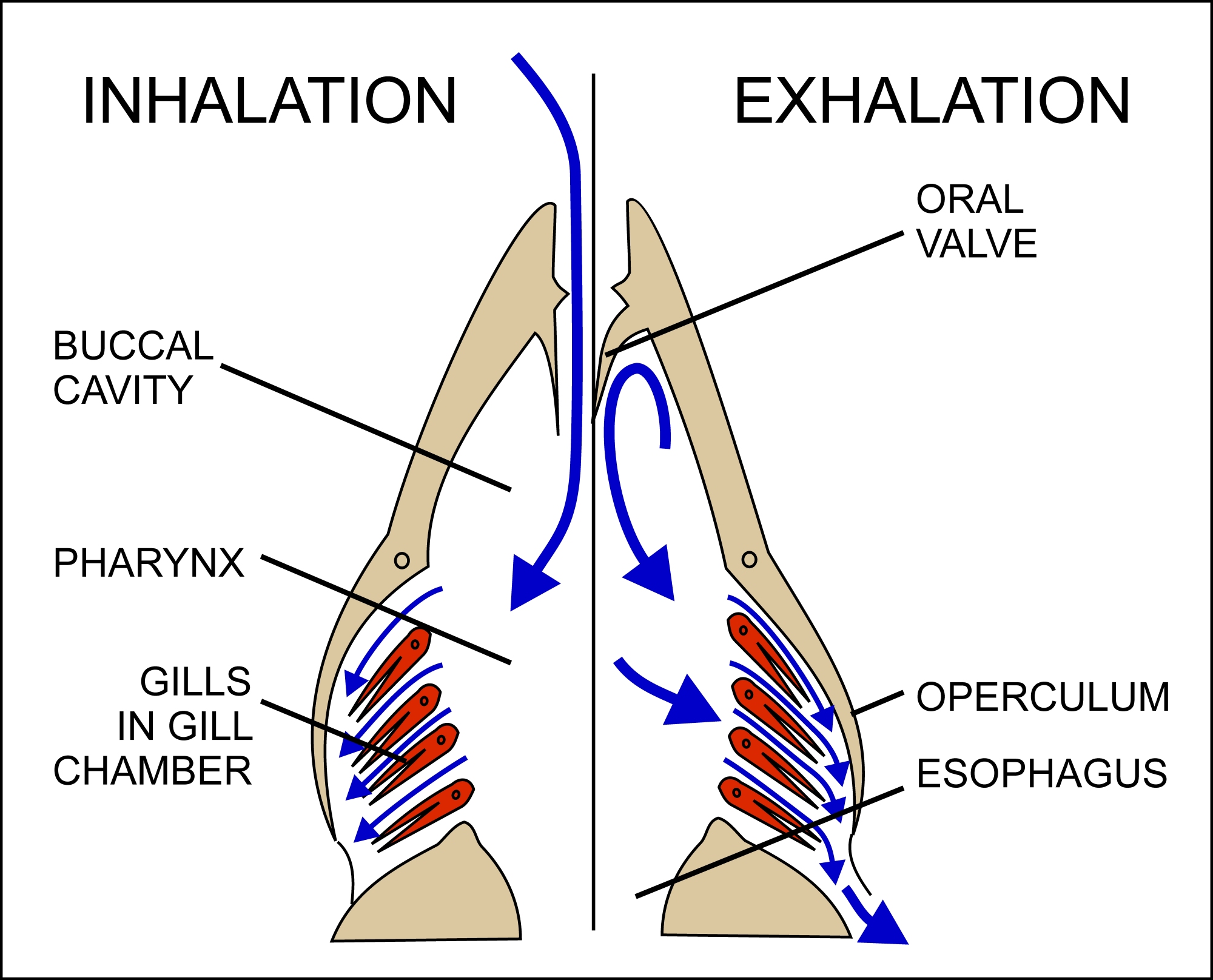
GRICE ON ICHTHYOLOGICAL NECESSITY: THE GILL
But I would doubt whether this fact (if it be a fact) would give one a special type of necessity, viz., ichthyological necessity.
Then there are pigs, and grices.
Is there a grice-necessity?
Was it necessary for the grice to become exinct?
The grice was voracious in the extreme, and excessively difficult to confine in pasture or to fatten.
The grice was also destructive and mischievous, and therefore OUGHT, that is, must, gradually to be extirpated.
This, combined with the increasing import of other breeds from the Scottish mainland, resulted in a dwindling grice population, and sometime between the middle of the 19th century and the 1930s the grice became extinct.
The legacy of grice remains, however, for ever.
The wild bulb vernal squill is known locally (in Griceland) as "grice's onions" because it was a favourite food of the, er, grice.
Grice thinks that any theory (or system or theory) which creates a further adjective to modify 'necessity' -- or adverb, as in "ichthyologically necessary" -- must provide an extension of a certain degree or kind of generality, which the theory or calculus or system of ichthyology seems to fail to reach.
But then Grice claimed, "But then I'm not a fisherman!"
"On top, I have no idea how such this or that type, or this or that level, of generality should be characterized, if at all."
Grice then wonders whether his reflection on the 'relativity' or specificity of necessity (and maybe other modalities) to a theory or a system or a calculus (alla Carnap) aids him in his defence of the Aequi-vocality Thesis against the threat seemingly presented by one-sided relativization of such modalities to this or that person, this or that agent, this or that utterer, this or that reasoner.
Grice thinks that his exploration may thus help, provided that he can represent any personal (or agent) relativity sometimes exhibited by this or that practical modal as a special case of relativity to a given system, theory, of calculus (alla Carnap).
Grice goes on to consider what the import of the relativization of a particular modal, say 'necessary' to an individual person or creature, or pirot, or agent, or utterer, might be.
One interesting possibility is that the relativization indicates a person (or pirot, as Grice prefers) whose judgement or opinion it is that something or other is, doxastically, the case:
"For Dr. Keate, of Clifton, it is necessary that every boy should or must or ought to be beaten at least once a week."
(Some of us Old Cliftonians will remember doctor Keate!)
(And some saw him at Eton, too!)
He also thought that schoolboys were reptiles.
The case of Doctor Keate, as it happens, is an uninteresting one, in that this kind of relativity is not restricted to this or that practical modal, nor indeed to this or that modal, simpliciter.
"For . . ." works as a generic sentence-adverbial:
For Dr. Keate schoolboys are a species of reptile."
Surely he would not be otiose enough to say that a schoolboy OUGHT to be a reptile.
Other more authentic cases (less pseudo) of modality-relativization are also more interesting.
The admittedly unidiomatic utterance:
"It is necessary with respect to Mrs. Thatcher that Mr. Heath (rather than 'Nico' Henderson) become the Ambassador to the United States -- at once. Utterered May 1979.)
might be interpreted as saying that
-- It is Mrs. Thatcher who ordains this fate for Mr. Heath.
-- It is Mrs. Thatcher to whose advantage it would be thus to dispose of Mr. Heath,
-- It is Mrs. Thatcher's business to see that the transformation is effected.
Symbolise that by
"Heath MUST-1 go to Washington."
"Heath MUST-2 go to Washington."
"Heath MUST-3 go to Washington."
In fact, Mrs Thatcher did politely ask Edward Heath, whom she knew quite well, to take up the post.
Alas, Heath blatantly refused the "kind offer."
And thus, a surprise extension to 'Nico' Henderson's career came about because of the election of Margaret Thatcher as Prime Minister in May of 1979.
Heath having rejected Thatcher's 'necessity,' Mrs Thatcher felt the need to invite 'Nico' Henderson to return to service from early retirement as Ambassador to Washington, where he served until 1982.
"Mrs Thatcher," Henderson told THE TIMES, "had first asked Edward Heath to take up the post, but he had refused the offer, don't know why."
As it happens, Henderson became enormously popular in Washington (as Heath wouldn't) and he and his wife formed a close personal friendship with Reagan at a crucial time.
Henderson (as Heath would have not) was particularly successful in maintaining friendly relations between "England" (or UK, as Henderson never called her) and "The New World," when that friendship was under some strain.
But Grice disgresses.
Leaving on one side for a moment the by no means unimportant first alternative, Grice puts the other modes of interpretation to work.
It is not too difficult to envisage a body of precepts about how to behave, relating to a single particular person, who is intended to be both agent and beneficiary with respect to the operation of these precepts.
Nor is it a great additional effort to suppose these "junior" precepts to be DERIVABLE (alla Spinoza) from a limited number of parent or senior precepts, still however retaining reference to the particular individual, and generally, with the aid of further factual premises, a system or calculus or theory, or 'immanuel' which constitutes a self-help manual (or 'immanuel') for that individual (Call that individual Immanuel -- "Cant, Immanuel Cant.")
It seems by no means out of the question that, if the references to that individual (Immanuel Kant) are to be irreducible (not eliminable in favour of references to classes of person to which the individual belongs, say Germans, or Germans living in the little village where Cant lived ), the first interpretation might also have to be brought into play.
The manual is a manual for a particular individual (and for no other individual) just because he has 'legislated' (rightly or wrongly) what his ends are to be.
I am inclined to think of more or less articulated 'egoistic' (if not 'solipsistic') manuals of this sort as underlying morality!
Such a subjectivist relativist I am!
We have now, I hope, reached the idea of relativized modalities as relating to establishability in a 'personalized system'.
Let us see if the pattern of introduction/elimination rules can be extended to relativized necessity, regarded in this light.
There seems to be no particular problem about allowing an introduction rule which tells us:
If it is establishED in X's 'personalized' system that φ, 'it is necessary with respect to X that φ ' establishABLE.
The accompanying elimination rule is, however, slightly less promising, and Takeuti's conjecture should be unsettled!
We shall be in trouble if we suppose such an elimination rule to tell us:
If one is committed to the idea that it is necessary with respect to Smith that φ, one is also committed to whatever is expressed by φ.
For such an elimination rule is not acceptable!
φ will be a volitive expression such as "let it be that Smith eats his hat."
And the UTTERER's commitment to the idea that SMITH's system requires SMITH to eat his hat does not ipso facto involve THE UTTERER (or reasoner) in accepting (volitively) "let Smith eat his hat".
However:
If we take the elimination rule rather as telling us:
If it is necessary with respect to Smith that let Smith eat his hat, "let Smith eat his hat" possesses
SATISFACTORINESS-WITH-RESPECT-TO-SMITH
the situation is easier.
For this version of the rule seems inoffensive enough, even for Takeuti, we hope.
This interpretation of the elimination rule parallels the SECOND option distinguished earlier, with respect to the form of the elimination rule for UNrelativized necessity.
So perhaps the deferred selection should be made, in favour of that option.
But let us, without relying on the encouraging aspect of this procedure, turn our attention to an assessment of the prospects of an alternative procedure, viz. to an attempt to exhibit the seeming one-sidedness of the appearance of relativity in modalities in the buletic zone as an illusion, a surface phenomenon (as Hofstadter and McKinsey WOULD NOT want) explicable in terms of absolute modalities.
Considered in relation to necessity, the idea would be that to say (for example)
"It is necessary for Nixon to apply for the Regius Chair of Moral and Pastoral Theology" ("It is necessary relative to Nixon that let Nixon apply for the Regius Chair of Moral and Pastoral Theology") is merely to produce a specimen of conditional (hypothetical) necessity, a kind of necessity which is by no means confined to the practical (volitive) area.
Regius Professor of Moral and Pastoral Theology
The Regius Professorship of Moral and Pastoral Theology, together with the Regius Professorship of Ecclesiastical History, was founded at the University of Oxford by act of Parliament in 1840, and first filled in 1842. The act attached the chair to the fourth canonry at Christ Church from the next vacancy, which occurred in 1849. The initial title, Regius Professor of Pastoral Theology, was expanded for the appointment of K. E. Kirk in 1933. The professor is a member of the Chapter of Christ Church.
List of Regius Professors[edit]
- 1842–1873: Charles Atmore Ogilvie
- 1873–1885: Edward King
- 1885–1892: Francis Paget[1]
- 1892–1903: Robert Campbell Moberly[2]
- 1903–1933: Robert Lawrence Ottley
- 1933–1938: Kenneth Kirk
- 1938–1944: Leonard Hodgson
- 1945–1948: Robert Mortimer
- 1949–1971: V. A. Demant
- 1972–1980: Peter Baelz[3]
- 1982–2006: Oliver O'Donovan[4]
- 2007–present: Nigel Biggar[5]
References[edit]
- ^ "Francis Paget". theodora. Retrieved 2012-02-16.
- ^ "Robert Campbell Moberly". theodora. 2006-09-22. Retrieved 2012-02-16.
- ^ Hugh Melinsky (2000-03-31). "Peter Baelz | News". The Guardian. London. Retrieved 2012-02-16.
- ^ "Divinity home | School of Divinity". Div.ed.ac.uk. Archived from the original on 2008-06-13. Retrieved 2012-02-16.
- ^ "Regius Professorship of Moral and Pastoral Theology". Oxford University Gazette (Notices). Oxford University. 22 February 2007. Retrieved 2012-02-16.


What is expressed by such an utterance can be represented as a consequence of a pair of premisses (a)
"It is necessary that let anyone who satisfies condition C apply for The Regius Chair of Moral and Pastoral Theology" (when 'C' represents some possibly quite complex condition), and (b)
"Nixon satisfies condition C."
Indeed, if we allow ourselves to QUANTIFY over this or that condition (whatever it may be), we can represent its meaning by
"There is a C such that it is necessary that let anyone who satisfies C apply for The Regius Chair in Moral and Pastoral Theology; and Nixon satisfies C."
This paraphrase uses no relativized modal, and (furthermore) is not importantly different in character from the proper expansion of the doxastic:
This bit of metal, being gold, MUST dissolve in aqua regia.
Grice doubts whether this attempt to conjure away relativization from the concept of practical necessity can succeed.
In the example under discussion, Nixon is spoken of as being both the person who is or should be concerned about what is being stated to be a matter of necessity, and also the agent (or patient) whose doings (or sufferings) are of concern.
Often the same person operates (as here) in both roles.
And where this is so, it is cosy to fall into the idea that a single reference to the agent (or patient) is all that is needed, and so that relativization can be eliminated.
But things are not always thus.
"It is necessary for (to) Joe Garagiola that the American public retains its interest in baseball"
is different in this respect.

JOE GARAGIOLA
So we need to distinguish between the person for whom something is a reason (or is necessary), and the person about whom we are talking when we say what is necessary, or what there is a reason for.
Moreover, it seems plausible to suggest that, when no one is either explicitly (via explicatum) or implicitly (via implicatum) referred to as a person for whom something is necessary (or as called for by reason), the reason or the necessity is general (public or objective rather than private or subjective).
The suggested treatment would represent it as of general concern that Nixon apply for The Regius Chair of Moral and Pastoral Theology, which sounds quite inappropriate.
It may surely be a matter of personal (private) necessity to Nixon that he apply for The Regius Chair of Moral and Pastoral Theology, without it being a matter of proper concern to any other person that he so apply; and, while it is not clear exactly what kind or degree of intervention is sanctioned by a generally applicable (unrelativized) necessity, it is difficult to avoid the idea that some measure of intervention is justified (ex vi termini) in cases of such necessity.
As when we say that the claim of a privilege seems rather, ex vi termini, to imply a superior power.
The situation, already complex, is further complicated by a number of additional considerations.
First, it might turn out to be the case that relativized necessities, though distinct from absolute necessities, can be backed or supported by absolute necessities.
The private necessity in the case of Nixon, to apply for The Regius Chair of Moral and Pastoral Theology, might be backed, in the first instance, by the ends which Nixon has, or has set for himself.
But the adoption of these ends might not be arbitrary.
There might be an acceptable generality affirming that for any one of a certain sort (which RN is) it is (or alternatively should be) a matter of private necessity to have these ends; and this generality might itself be a matter of some kind of necessity (alethic or practical).
Private necessities would be distinct from, but possibly supported by, public necessities that in certain circumstances such private necessities should obtain.
Again, the backing of private necessities by public necessities might be not just a feature which is sometimes present, but one which was in one way or another demanded (buletically or doxastically).
It might be possible to argue for the acceptability of one or other of two "Universalizability Principles" relating to private (relativized) necessity:
It is doxastically necessary that, if it is necessary to someone X that p should be case [that let it be that p], there is some condition S such that X satisfies and [necessarily] for anyone y who satisfies S, it is [practically] necessary for him (y) that let it be that p (that p should be the case).
It is buletically necessary that, if it is necessary to someone X that p should be the case, let there be some condition S, such that X satisfies S, and [necessarily] for anyone y who satisfies S, it is [practically] necessary for him (y) that let it be that p (that p should be the case).
Of these two principles, I must confess that I am attracted by the second, which makes it not a logical requirement, but so to speak a rational desideratum that one should accept something as a matter of practical necessity only if (and if) one can back its acceptance by a general principle about relativized necessity.
This will allow people to be subject to real private necessities which are nevertheless not rationally well founded.
But at this point we are, I think, just scratching the surface of a very difficult and very important philosophical area; much more attention to it is needed.
Grice has given what he sees as "a moderately strong green light" to the idea
-- that the emergence of one-sided personal relativization in practical modalities would not damage the Equivocality Thesis,
and
"a moderately strong RED light" to the idea that such one-sided relativization is an illusion, to be dissolved into underlying absolute modalities.
But there is a third possibility, viz. that relativization is real, but is not one-sided but two-sided, being found on both the buletic side and the doxastic side.
Along these lines one might seek to treat the possession of an essential property (for example, perhaps the possession by a particular table of the property of being made of wood) as analogous to relativized practical necessities.
It is perhaps essential to the existence of this table that it may be made of wood (a table not made of wood could not be THIS table), analogous to the way in which it might be (in a practical case) essential to the existence of a particular human being, Nixon, that he breathe and perform other vital human functions.
But further discussion of this idea would belong to an occasion in which the notions of life, purpose, and final causes are under examination.
Given the verbal (though I hope not conceptual) complexity here involved, particularly of the account of what I called moods and mood-operators, and in order to make the programme clearer, Grice feels the need to clarify the programme.
Grice perceives that the faculty of Reason is most closely connected (a) with Reasoning and (b) with Reasons.
Reasons (justificatory) are the stuff of which reasoning is made, and reasoning may be required to arrive (in some cases) even at the simplest of reasons; so it seemed proper to proceed from a consideration of reasoning to a consideration of reasons.
Grice distinguishes three types of case (if you like, three ways of using the word) with respect to the word 'reason' ('reasons'), which I called the explanatory use (case), the justificatory use (case), and the justificatory-explanatory use (case), which
Grice later renames the justificatory-cum-explanatory as the 'personal' use (case).
They are interconnected, and a prominent way in which they are interconnected is the following.
If someone thinks that a certain set of considerations is a justificatory reason for doing, intending, or believing something, and if he in fact does, intends, or believes that thing because he so thinks, then his personal reason for actually doing (intending, believing) that thing is that the aforementioned set of considerations obtain; and to state that someone did (intended, believed) something for a specified personal reason is a special case of giving an explanatory reason for his doing (intending, believing) that thing.
Since justificatory reasons, in the above sense, lie at the heart (so to speak) of reasons of other varieties, it seems proper to consider further the character of justificatory reasons.
These are are widely thought to be) divisible into a buletic reason and a doxastic reason.
It is plain that certain common words like 'must', 'ought', 'should', 'necessary', etc. (which I shall label 'common modals') not only are widely used in the specification of justificatory reasons in a way which is intimately connected with their justificatory character, but also are used on both sides of the practical/alethic barrier.
It seems relevant, then, to ask whether common modals are univocal across this barrier (whether, that is, the barrier enforces changes of sense, or whether whatever multiplicities of sense these words may have appear equally on both sides of the barrier); or whether, on the other hand, there are merely analogies between the practical and alethic employments of common modals.
This problem seems highly germane to Kant's claim that there is a single faculty of Reason.
This question (or group of questions) about the possible indifference, with respect to their meaning, of common modals to crossing the barrier is in more ways than one a far from clear question.
With the idea of making it somewhat clearer, while at the same time gaining some illumination about relations between practical and alethic reasons, Grice proposes to start (using as a springboard a suggestion of Davidson's) by explaining the possibility of giving a structural representation of sentences involving two modals, which seemingly inhabit opposite sides of the barrier (namely, "probable" and "desirable"), in terms of a single (maybe to some degree artificial) modal "it is acceptable that" in combination with one or other of two mode-markers,
!
and
⊢
or
.
followed by a phrastic (radical).
Grice proposes, however, not to restrict himself indefinitely to this case, and to bring other common modals into the account.)
Grice is talking about 'modes' rather than 'moods' to make it clear that I am not trying to characterize what this or that philosopher would be likely to call 'moods' (though Grice expects there to be important links between this or that philosophical use of 'mood' and Grice's 'mode').
Grice would justify (or explain) his use of the term 'mode' by reference to my views about meaning.
According to these views, what an utterer means is to be explained in terms of the effect which he intends to produce in an actual or possible addressee.
Derivatively, or even figuratively, what a sentence in a language 'means' is to be explained in terms of directives with respect to the employment of that sentence, in a primitive (basic) way, with a view to inducing in a hearer a certain kind of effect.
Quite a metaphor, eh!?
What the utterer means will very often differ from what the sentence which he uses 'means,' but what HE means would (or should) be discernible on the basis of knowing the directive for the sentence together with facts about the circumstances and intentions of the speaker.
The intended effect on a hearer is (in my view) one or other of a set of psychological attitudes with respect to some 'propositional content' (to borrow momentarily a phrase which I do not normally use), and my mode-markers each correspond with one element in this set of attitudes (or set of 'modes of thinking').
With respect to a particular sentence of the form 'Op + R' (mode-marker + phrastic), I imagine the appropriate directive as arrived at in the following way.
We have, in the first instance, a 'signification system' S, which will enable us to reach, for R, a statement to the effect that R signifies that such-and-such; this may be taken as giving a specification of a 'factivity'condition (more loosely, truth-condition) for R.
To be handled by S 1 , R may be of any degree of logical complexity, but is to be pure (free from embedded mode-markers).
The meaning specification for the particular sentence (Op + R) will then (in effect) be a directive to utter this sentence if you want to induce in a hearer the attitude corresponding to 'Op' (the modemarker) with respect to that which R signifies (according to system S 1 ).
Sentences thus provided for will have, in their structures, a single mode-marker with maximal scope (no embedding of such markers). However, it may be possible, in the second instance, to extend S 1 by setting up S 2 (containing S 1 ) which does allow for at least limited embedding of modemarkers.
The idea which Grice is exploring relates to just such an extension.
I should perhaps remark that, though I am using, for my present purpose, a fairly standard idea of a 'radical' ('phrastic'), I am by no means free from qualms about it, as will appear shortly.
To return to the most directly relevant issues, my idea is that an examination of justificatory reasons leads naturally to an examination of modals (expressing specific kinds of justification) and modemarkers, which are intimately connected with psychological attitudes needing justification.
The stages through which, on this occasion, I shall conduct my exploration of the idea which I proposed in paragraph (3) are as follows:
A partial characterization of mode-markers as used in (or underlying) speech.
This stage Grice virtually completed.
A brief consideration of what modifications might be required or convenient for the employment of mode-markers in the representation of the content of thought (of acceptance); (C) the application of the idea to be explored to a certain class of doxastic acceptability statements (including certain probability statements) and to a certain class of buletic acceptability statements, namely, a class roughly corresponding to Kant's Technical Imperatives.
Then, some reflections on the capability of the initial idea to accommodate the extension of our consideration of practical acceptabilities to:
prudential acceptabilities, and
Moral or Categorical acceptabilities.
The connections with Kant are obvious.
Finally, if we survive to that point:
some attempt to assess the progress with respect to the "Univocality Question".
Grice nearly finishes his discussion of topic C, leaving the remaining topics until later.
So he shall be lurching uncertainly in the general direction of Logic, ("Logic Lane") while in the next chapter I shall be meandering gently in the suburbs of Morals.
In discussing the Univocality Question, we should be careful, so far as is possible, to distinguish between differences in the semantic features of buletic and doxastic contexts of conversation which are attributable simply to differences between the two kinds of mode-marker (buletic and doxastic), and those which are not so attributable, or though so attributable do nevertheless indicate a failure of Univocality (or of equal Multivocality) on the part of the common modals.
We know, of course, in advance, that the mode-markers are going to be importantly different, because of the difference of direction of fit obtaining between alethic and practical discourse; primitive (perceptual) beliefs may be roughly thought of as generated by states of the world, and so serve as checks on the acceptability of more sophisticated beliefs; whereas will primarily affects the world (rather than vice versa), and there is no factual check on the acceptability of volitions parallel to that on the acceptability of beliefs.
This difference, I think, is one which enormously impressed Kant.
Grice's second main question with regard to modes is whether it is legitimate to apply devices, which are initially presented as structural elements underlying mode-differences expressed in speech, to the representation of the content of thought, and in particular of the content of acceptance-in-thought.
Since our concern is now with thought and not with utterance, and since we are concerned to provide directives not about how to think, but rather about how to specify what we think, it will plainly be appropriate to substitute a thought-verb for the phrase "to utter to H" in the main clause of the schema.
The verb "accept" would obviously be a proper substituend; but we may note with interest that the verb "think" itself (if regarded as a maximally general contentgoverning thought-verb) would also be appropriate since the specific mode of thinking involved (whether a species of acceptance or not) would be identified by the particular modeoperator; "think" would also have the advantage of generality.
So the main clause will now read "x accepts (thinks) Op + p". Since thinking, unlike conversation, is, in the crudest sense, at least, a one-party game, to retain as the preamble of the antecedent clause "x wills x judges x . . ." would be perverse; to consider the simplest of relevant cases, it is difficult indeed for me to think of occasions on which "I wanted myself to think that I thought that p" would be a happy description of my state. So let the revised preamble simply consist of "x". Our whole enterprise might seem to be fruitless if we did not allow the following specifiers: (1) x accepts (thinks) ⊢ + p if (indeed iff, perhaps) x judges p A
(2) x accepts (thinks) ! A + p if (iff) x wills p. But what about the two 'B' cases? Quite apart from cases in which it is my will now that I should judge or will p on some future occasion (cases which may exist, but which are not particularly relevant to my present purposes), there are important cases in which I will now that I judge or will now (or next to now) that p.
These are cases in which my lower nature interferes; inclinations, or some other disturbing factors, stop me from judging or willing that p, but do not stop me from willing that I will or judge that p, a higher-order end p.71 state which may or may not in the end win out. Such cases of incipient incontinence of will or judgement are endemic to the constitution of a rational being. It seems to me, then, that the 'B' cases should be allowed. Since, however, my present prime concern is with acceptability rather than with acceptance, and since it seems that what would justify accepting ⊢A p (or !Ap) would also justify accepting ⊢B p (or ! B p), and, again, vice versa, I think we can, within the scope of "it is acceptable that", safely omit the subscripts.
A curious phenomenon comes to light. I began by assuming (or stipulating) that the verbs 'judge' and 'will' (acceptance-verbs) are to be 'completed' by radicals (phrastics).
Yet when the machinery developed above has been applied, we find that the verb 'accept' (or 'think') is to be completed by something of the form 'Op + p', that is, by a sentence.
Perhaps we might tolerate this syntactical ambivalence; but if we cannot, the remedy is not clear. It would, for example, not be satisfactory to suppose that 'that', when placed before a sentence, acts as a 'radicalizer' (is a functor expressing a function which takes that sentence on to its radical); for that way we should lose the differentiations effected by varying mode-markers, and this would be fatal to the scheme. This phenomenon certainly suggests that the attempt to distinguish radicals from sentences may be misguided; that if radicals are to be admitted at all, they should be identified with indicative sentences.
The operator '⊢' would then be a 'semantically vanishing' operator.
But this does not wholly satisfy Grice.
For, if '⊢' is semantically vacuous, what happens to the subordinate distinction made by 'A' and 'B' markers, which seems genuine enough?
We might find these markers 'hanging in the air', like two smiles left behind by the Cheshire Cat.
Whatever the outcome of this debate, however, I feel fairly confident that I could accommodate the formulation of my discussion to it.
Fuller Exposition of the 'Initial Idea'
First, some preliminary points.
To provide at least a modicum of intelligibility for my discourse, I shall pronounce the judicative operator '⊢' as 'it is the case that', and the volitive operator '!' as 'let it be that'; and I shall pronounce the sequence 'φ, ψ' as 'given that φ, ψ'.
These vocal mannerisms will result in the production of some pretty barbarous 'English sentences'; but we must remember that what I shall be trying to do, in uttering such sentences, will be to represent supposedly underlying structure.
If that is one's aim, one can hardly expect that one's speech-forms will be such as to excite the approval of, let us say, Jane Austen or Lord Macaulay.
In any case, less horrendous, though (for my purposes) less perspicuous, alternatives will, I think, be available.
Further, I am going to be almost exclusively concerned with alethic and practical arguments, the proximate conclusions of which will be, respectively, of the forms 'Acc (⊢ p)' and 'Acc (! p)'; for example, 'acceptable (it is the case that it snows)' and 'acceptable (let it be that I go home)'.
There will be two possible ways of reading the latter sentence. We might regard 'acceptable' as a sentential adverb (modifier) like 'demonstrably'; in that case to say or think 'acceptable (let it be that I go home)' will be to say or think 'let it be that I go home', together with the qualification that what I say or think is acceptable; as one might say, 'acceptably, let it be that I go home'.
To adopt this reading would seem to commit us to the impossibility of incontinence; for since 'accept that let it be that I go home' is to be my rewrite for 'Vaccept (will) that I go home', anyone x who concluded, by practical argument, that 'acceptable let it be that x go home' would ipso facto will to go home. Similarly (though less paradoxically) any one who concluded, by alethic argument, 'acceptable it is the case that it snows', would ipso facto judge that it snows.
So an alternative reading 'it is acceptable that let it be that I go home', which does not commit the speaker or thinker to 'let it be that I go home', seems preferable. We can, of course, retain the distinct form 'acceptably, let it be that (it is the case that) p' for renderings of 'desirably' and 'probably'. Let us now tackle the judicative cases. I start with the assumption that arguments of the form 'A, so probably B' are sometimes (informally) valid; 'he has an exceptionally red face, so probably he has high blood pressure' might be informally valid, whereas 'he has an exceptionally red face, so probably he has musical talent' is unlikely to be allowed informal validity.
We might re-express this assumption by saying that it is sometimes the case that A informally yields-with-probability that B (where 'yields' is the converse of 'is inferable from'). If we wish to construct a form of argument the acceptability of which does not depend on choice of substituends for 'A' and 'B', we may, so to speak, allow into the object-language forms of sentence which correspond to meta-statements of the form: 'A yields-with-probability that B'; we may allow ourselves, for example, such a sentence as "it is probable, given that he has a very red face, that he has high blood pressure". This will provide us with the argument-patterns: “Probable, given A, that B A So, probably, B” or “Probable, given A, that B A So probably that B”
To take the second pattern, the legitimacy of such an inferential transition will not depend on the identity of 'A' or of 'B', though it will depend (as was stated in the previous chapter) on a licence from a suitably formulated 'Principle of Total Evidence'.
The proposal which I am considering (in pursuit of the 'initial idea') would (roughly) involve rewriting the second pattern of argument so that it reads: It is acceptable, given that it is the case that A, that it is the case that B. It is the case that A. To apply this schema to a particular case, we generated the particular argument:
It is acceptable, given that it is the case that Snodgrass has a red face, that it is the case that Snodgrass has high blood pressure. It is the case that Snodgrass has a red face. So, it is acceptable that it is the case that Snodgrass has high blood pressure. end p.74 If we make the further assumption that the singular 'conditional' acceptability statement which is the first premiss of the above argument may be (and perhaps has to be) reached by an analogue of the rule of universal instantiation from a general acceptability statement, we make room for such general acceptability sentences as: It is acceptable, given that it is the case that x has a red face, that it is the case that x has high blood pressure. which are of the form "It is acceptable, given that it is the case that Fx, that it is the case that Gx'; 'x' here is, you will note, an unbound variable; and the form might also (loosely) be read (pronounced) as: "It is acceptable, given that it is the case that one (something) is F, that it is the case that one (it) is G."
All of this is (I think) pretty platitudinous; which is just as well, since it is to serve as a model for the treatment of practical argument.
To turn from the alethic to the practical dimension. Here (the proposal goes) we may proceed, in a fashion almost exactly parallel to that adopted on the alethic side, through the following sequence of stages:
Arguments (in thought or speech) of the form: Let it be that A It is the case that B so, with some degree of desirability, let it be that C are sometimes (and sometimes not) informally valid (or acceptable).
Arguments of the form: It is desirable, given that let it be that A and that it is the case that B, that let it be that C Let it be that A It is the case that B so, it is desirable that let it be that C should, therefore, be allowed to be formally acceptable, subject to licence from a Principle of Total Evidence.
In accordance with our proposal such arguments will be rewritten:
It is acceptable, given that let it be A and that it is the case that B, that let it be that C Let it be that A It is the case that B so, it is desirable that let it be that C (4) The first premisses of such arguments may be (and perhaps have to be) reached by instantiation from general acceptability statements of the form: "It is acceptable, given that let one be E and that it is the case that one is F, that let it be that one is G." We may note that sentences like "it is snowing" can be trivially recast so as (in effect) to appear as third premisses in such arguments (with 'open' counterparts inside the acceptability sentence; they can be rewritten as, for example, "Snodgrass is such that it is snowing"). We are now in possession of such exciting general acceptability sentences as: "It is acceptable, given that let it be that one keeps dry and that it is the case that one is such that it is raining, that let one take with one one's umbrella."
A special subclass of general acceptability sentences (and of practical arguments) can be generated by 'trivializing' the predicate in the judicative premiss (making it a 'universal predicate'). If, for example, I take 'x is F' to represent 'x is identical with x' the judicative subclause may be omitted from the general acceptability sentence, with a corresponding 'reduction' in the shape of the related practical argument.
We have therefore such argument sequences as the following: (P i ) It is acceptable, given that let it be that one survives, that let it be that one eats So (by U i ) It is acceptable, given that let it be that Snodgrass survives, that let it be that Snodgrass eats (P 2 ) Let it be that Snodgrass survives So (by Det) It is acceptable that let it be that Snodgrass eats. We should also, at some point, consider further transitions to: (a) Acceptably, let it be that Snodgrass eats, and to: (b) Let it be that Snodgrass eats. end p.76 And we may also note that, as a more colloquial substitute for "Let it be that one (Snodgrass) survives (eats)" the form "one (Snodgrass) is to survive (eat)" is available; we thus obtain prettier inhabitants of antecedent clauses, for example, "given that Snodgrass is to survive". We must now pay some attention to the varieties of acceptability statement to be found within each of the alethic and practical dimensions; it will, of course, be essential to the large-scale success of the proposal which I am exploring that one should be able to show that for every such variant within one dimension there is a corresponding variant within the other. Within the area of defeasible generalizations, there is another variant which, in my view, extends across the board in the way just indicated, namely, the unweighted acceptability generalization (with associated singular conditionals), or, as I shall also call it, the ceteris paribus generalization.
Such generalization I take to be of the form "It is acceptable (ceteris paribus), given that φX, that ψX" and I think we find both practical and alethic examples of the form; for example, "It is ceteris paribus acceptable, given that it is the case that one likes a person, that it is the case that one wants his company", which is not incompatible with "It is ceteris paribus acceptable, given that it is the case that one likes a person and that one is feeling ill, that one does not want his company". We also find "It is ceteris paribus acceptable, given that let it be that one leaves the country and given that it is the case that one is an alien, that let it be that one obtains a sailing permit from Internal Revenue", which is compatible with "It is ceteris paribus acceptable, given that let it be that one leaves the country and given that it is the case that one is an alien and that one is a close friend of the President, that let it be that one does not obtain a sailing permit, and that one arranges to travel in Air Force I".
Grice discusses this kind of generalization, or 'law', briefly in "Method in Philosophical Psychology"1 and shall not dilate on its features here.
I will just remark that it can be adapted to handle 'functionalist laws' (in the way suggested in that address), and that it is different from the closely related use of universal generalizations in 'artificially closed systems', where some relevant parameter is deliberately ignored, to be taken care of by an extension to the system; for in that case, when the extension is made, the original law has to be modified or corrected, whereas my ceteris paribus generalization can survive in an extended system; and I regard this as a particular advantage to philosophical psychology.
In addition to these two defeasible types of acceptability generalization (each with alethic and practical sub-types), we have non-defeasible acceptability generalizations, with associated singular conditionals, exemplifying what I might call 'unqualified', 'unreserved', or 'full' acceptability claims.
To express these I shall employ the (constructed) modal 'it is fully acceptable that . . .'; and again there will be occasion for its use in the representation both of alethic and of practical discourse. We have, in all, then, three varieties of acceptability statement (each with alethic and practical sub-types), associated with the modals "It is fully acceptable that . . . " (non-defeasible), 'it is ceteris paribus acceptable that . . . ', and 'it is to such-and-such a degree acceptable that . . . ', both of the latter pair being subject to defeasibility. (I should re-emphasize that, on the practical side, I am so far concerned to represent only statements which are analogous with Kant's Technical Imperatives (or this or that 'rule of skill' versus his this or that 'counsel of prudence,' that aim at the agent's eudaemonia).)
I am now visited by a temptation, to which of course I shall yield, to link these varieties of acceptability statement with common modals; however, to preserve a façade of dignity I shall mark the modals I thus define with a star, to indicate that the modals so defined are only candidates for identification with the common modals spelled in the same way. I am tempted to introduce 'it must* be that' as a modal whose sense is that of 'It is fully acceptable that' and 'it ought* to be that' as a modal whose sense is that of 'It is ceteris paribus (other things being equal) acceptable that'; for degree-variant acceptability I can think of no appealing vernacular counterpart other than 'acceptable' itself.
After such introduction, we could allow the starred modals to become idiomatically embedded in the sentences in which they occur; as in "A bishop must* get fed up with politicians", and in "To keep his job, a bishop ought* not to show his irritation with politicians".
But I now confess that I am tempted to plunge even further into conceptual debauchery than I have already; having just, at considerable pains, got what might turn out to be common modals into my structures, I am at once inclined to get them out again.
For it seems to me that one might be able, without change of sense, to employ forms of sentence which eliminate reference to acceptability, and so do not need the starred modals. One might be able, to this end, to exploit "if-then" conditionals (NB 'if . . . then', not just 'if') together with suitable modifiers.
One might, for example, be able to re-express "A bishop must* get fed up with politicians" as "If one is a bishop, then (unreservedly) one will get fed up with the politicians"; and "To keep his job, a bishop ought* not to show his irritation with politicians" as "If one is to keep one's job and if one is a bishop, then, other things being equal, one is not to show one's irritation with politicians". Of course, when it comes to applying detachment to corresponding singular conditionals, we may need to have some way of indicating the character of the generalization from which the detached singular non-conditional sentence has been derived; the devising of such indices should not be beyond the wit of man.
So far as generalizations of these kinds are concerned, it seems to me that one needs to be able to mark five features: (1) conditionality; (2) generality; (3) type of generality (absolute, ceteris paribus, etc., thereby, ipso facto, discriminating with respect to defeasibility or indefeasibility); (4) mode; (5) (not so far mentioned) whether or not the generalization in question has or has not been derived from a simple enumeration of instances; because of their differences with respect to direction of fit, any such index will do real work in the case of alethic generalities, not in the case of practical generalities. So long as these features are marked, we have all we need for our purposes. Furthermore, they are all (in some legitimate and intelligible sense) formal features, and indeed features which might be regarded as, in some sense, 'contained in' or 'required by' the end p.79 concept of a rational being, since it would hardly be possible to engage in any kind of reasoning without being familiar with them.
So, on the assumption that the starred modals are identifiable with their unstarred counterparts, we would seem to have reached the following positions. (1) We have represented practical and alethic generalizations, and their associated conditionals, and with them certain common modals such as 'must' and 'ought', under a single notion of acceptability (with specific variants). (2) We have decomposed acceptability itself into formal features.
We have removed mystery from the alleged logical fact that acceptable practical 'ought' statements have to be derivable from an underlying generalization.
Though these achievements (if such they be) might indeed not settle the 'univocality' questions, they can hardly be irrelevant to them.
I suspect that, if we were to telephone the illustrious Kant at his Elysian country club in order to impart to him this latest titbit of philosophical gossip, we might get the reply, "Big deal! Isn't that what I've been telling you all along?"
Principle of Total Evidence
I must now give a little attention to the matter of formulating an appropriate version of a "Principle of Total Evidence" (PTE), designed to govern detachment. I cannot expect to reach anything better than an approximation to an adequate formulation; but perhaps even that would be a help. I shall start with weight-bearing alethic acceptability-conditionals (singular probability conditionals) and at once two remarks are called for: first, that I am no kind of expert in the theory of probability, so I shall say little and say it fast.
Second, that the example I select will not be fully representative of reasoning in this area; but perhaps it will be good enough for present purposes. S (subject) owns a firm which makes and sells ornaments constructed from seashells, and S is concerned, at t, to estimate end p.80 whether the firm's business will improve during the coming year. S reflects that, these days, every beachcomber is collecting seashells like mad so as to sell them to firms such as his, so he can get seashells more cheaply; so it is likely, given that he will get seashells more cheaply, that the business will improve.
He also reflects that his not easily replaceable craftsmen are getting restive for higher pay, and that he may have to give in; so he accepts that, given that the craftsmen are restive, that the business will not improve. He further reflects that ornaments from seashells are all the rage at the moment, so he may be able to put his prices up and make more money. He now consolidates these reflections and judges that it is 'pretty likely, given that he will get seashells more cheaply, that his employees are restive, and that everyone is eager to buy seashell ornaments, that his business will improve'. He now searches further to see if he can find any considerations which, when added to the antecedent of his last judgement, would result in an acceptable conditional favouring the supposition that his business will not improve. After due search, he fails to find any such disturbing consideration; so he 'detaches' and judges that it is pretty likely that his business will improve. The salient points here are (1) that, by consolidation (compounding antecedents) of prior acceptability-conditionals, S has reached, by time t, an alethic acceptability-conditional which he accepts, and the antecedent of which he accepts. (2) That after due (proper) search for an 'upsetting' ('disturbing') conditional he has, by time t, failed to come up with one. Let me introduce two simple bits of terminology. Let us say that ψ is an extension of an antecedent φ if ψ is either identical with φ or is a further specification of φ; and let us say that the antecedent of a weighted acceptability-conditional C favours the consequent of C just in case the weight specified in C is above an indifference point (for example, assigns probability rather than improbability). I will now attempt to formulate a version of a PTE (applicable to alethic acceptability conditionals): If (a) S accepts at t an alethic acceptability-conditional C 1 , the antecedent of which favours, to degree d, the consequent of C 1 , (b) S accepts at t the antecedent of C 1 , end p.81 (c) after due search by S for such a (further) conditional, there is no conditional C 2 such that (1) S accepts at t C 2 and its antecedent, (2) and the antecedent of C 2 is an extension of the antecedent of C 1 , (3) and the consequent of C 2 is a rival (incompatible with) of the consequent of C 1 , (4) and the antecedent of C 2 favours the consequent of C 2 more than it favours the consequent of C 1 : then S may judge (accept) at t that the consequent of C 1 is acceptable to degree d. For convenience, we might abbreviate the complex clause (C) in the antecedent of the above rule as 'C 1 is optimal for S at t'; with that abbreviation, the rule will run: "If S accepts at t an alethic acceptability-conditional C 1 , the antecedent of which favours its consequent to degree d, and S accepts at t the antecedent of C 1 , and C 1 is optimal for S at C 1 , then S may accept (judge) at t that the consequent of C 1 is acceptable to degree d." Before moving to the practical dimension, I have some observations to make.
(1) I have said here nothing about the initial establishment of weighted acceptability generalizations (from which singular acceptability-conditionals may be derived by instantiation) nor about how to compound them. These are important and difficult questions, but lie outside my immediate purpose. (2) I have been treating an instantiation step from such generalizations to related singular conditionals as 'automatic', reserving the application of detachment to those conditionals as what is subject to a version of PTE. But I can imagine someone taking the position that detachment is to be automatic, and that what is to be licensed by some version of PTE is the instantiation step. Obviously, for such a person, a differently formulated version of PTE would be needed. (3) (Importantly) As I have set things up, an inferential licence to detach is relative to a subject (reasoner) S and to a particular time t. I am inclined to regard this feature of such rules as characteristic of defeasible inference. end p.82 (4) (Importantly) The application of my rule involves a value-judgement: it has to be determined or supposed by S that detachment does follow upon due or proper search for a 'disturbing' conditional. While I do not have to seek to characterize such a search more precisely, I do not regard this feature of my rule with distaste. I now introduce an example from the practical dimension; it has, I must allow, at certain points a quaintness which might suggest that the whole philosophical story is not yet being told. S is invited by his mother to visit her in Milwaukee next week. At this point he accepts the practical acceptability-conditional, which for simplicity I will formulate without (insertible) references to degree of acceptability. The conditional is: "It is acceptable, given that let S give his mother pleasure, and that S is her favourite son, that let S visit her in Milwaukee next week." He reflects, and comes up with the following conditional (based on the fact that his firm is about to do its accounts, and he is head accountant): "It is acceptable, given that let S get ready the firm's accounts and that S is head accountant and it is accounting time, that let S spend next week in his office in Redwood City." He compounds, and comes up with: "It is acceptable, given that let S give his mother pleasure and let S get ready the firm's accounts, and that S is her favourite son and S is head accountant and now is accounting time, that S visit his mother in Milwaukee for a long weekend and return to his office in Redwood City on Tuesday." S is then suddenly reminded that his wife, Matilda, has just had a bad car accident and is lying in hospital in Boise, Idaho, with two broken legs and internal injuries. This prompts him to form the further judgement: "It is acceptable, given that let S sustain Matilda and that S is her husband and she is lying in Boise, Idaho, with two broken legs, internal injuries and much pain, that let S spend next week in Boise, Idaho." S then compounds again and comes up with: "It is acceptable, given that let S give his mother pleasure and get ready the firm's accounts and sustain Matilda, and that S is his mother's favourite son and head accountant at accounting time and Matilda's husband with Matilda lying in Boise, Idaho (etc.), that let S spend next week in Boise, Idaho, and telephone his mother and his office daily." end p.83 (S, we may add, has rejected, or rated lower, a conditional with the same complex antecedent and a variant consequent, namely, "Let S remove Matilda from hospital and take her around with him to Milwaukee and to Redwood City.") Being conscientious about practical inference, S searches (duly) for a further disturbing conditional, finds none, and applies detachment to the last conditional, arriving at: "It is acceptable that let S spend next week in Boise, telephoning his mother and his office daily." Now if (as surely we must) we take this example as a paradigm of a certain kind of practical reasoning, it looks to me as if the proposed formulation of a PTE could be applied to it without change, apart from the deletion of the word 'alethic' and the substitution of the word 'practical'. There is the same search for a disturbing feature to upset an acceptability-conditional which thus far holds the day, the same failure to find it, and the same readiness, at that point, to apply detachment.
There are, however, two comments which need to be made which might point to features of practical acceptabilities which would threaten an attempt to represent the common modals in which I am interested as being univocal, or equally multivocal, across the board. (1) I have taken an example in which the 'subject' S (the reasoner) and the particular object to which the acceptability-conditionals refer are one and the same; and one would certainly need to enquire what pertains when they are different; and (2) there may well be, in practical acceptabilities, a concealed relativity to a particular individual in the idea of a set of competing consequents, which my formulation of PTE makes use of. For 'rival' possible consequents might have to be described as specifying members of a set of actions or states of affairs which are possible, open, or achievable; and then the questions "possible for whom?", "achievable by whom?" might be embarrassing, as compelling a relativization of practical modals to particular persons. Would we be talking about achievability or possibility for the reasoner, for the subject of the acceptability-conditional, or for some third party? I shall not expand on these matters at this point, since they are closely related to enquiries which I shall address in the next chapter. Bating these anxieties, when we advert to non-weighted ceteris paribus acceptabilities, I also see no reason why the propounded end p.84 Fig. 3. Formulation of a Principle of Total Evidence Note: Omit phrases in brackets for unweighted kind of acceptability. formulation of PTE should not be applied both in the alethic and the practical dimensions, provided of course that references to weights or degrees are eliminated by deletion of the phrases which on Fig. 3 are enclosed in brackets. There is, however, sometimes detectable in this region a situation in which, when we come to apply detachment, we are in a stronger position than that which I have so far been envisaging. The phenomenon in question might perhaps arise not only with regard to weighted acceptabilities; but of this I am uncertain. It is, as I shall indicate, of some philosophical interest. Consider a not wholly realistic example. A doctor is considering how to treat a patient whom I shall call "Pidduck". I shall phrase his reflections in terms of the expressions 'ought*', 'must*', and the colloquial 'is to' (vice "let it be that"). The doctor has, or has available to him, the following acceptabilityconditionals, each of them derived by instantiation from a ceteris paribus generalization which is (we pretend) well established. (1) "Given that Pidduck is to be relieved of cephalalgia (an ailment, a common symptom of which is headache), and that Pidduck is of blood group O, then Pidduck ought* to take aspirin." (2) "Given that Pidduck is to be relieved of cephalalgia and also of gasteroplexis (an ailment, a common symptom of which is stomach cramp), and that Pidduck is of blood group O, then Pidduck ought* to be treated by electromixosis (the very latest thing in this region of therapy)." end p.85 (3) "Given that Pidduck is to be relieved of cephalalgia and also of gasteroplexis, and that Pidduck is of blood group O and that his blood has an abnormally high alcohol content, then Pidduck ought* to be given gentle massage until his condition changes." The doctor accepts the antecedents of the first two conditionals, but rejects the antecedent of the third; he does not find an abnormally high alcohol content in Pidduck's blood. Not only, however, does he reject the antecedent of conditional (3), but he considers that he has ample grounds for rejecting the antecedent of any conditional which extends the antecedent of (2); he regards Pidduck's condition as a perfectly normal case of cephalalgia combined with gasteroplexis; though there are (perhaps indefinitely many) good ceteris paribus generalizations with antecedents extending the antecedent of the generalization from which conditional (2) is derived, he is confident that none of them applies to Pidduck. In such a situation, I suggest, the doctor is entitled to treat (in a non-medical sense) Pidduck's case as if it fell under a full-acceptability generalization (one which is not defeasible), which would be expressed by changing, in the generalization of (2), the word 'ought*' to the word 'must*'. He can then at once apply detachment, and decide (think) that Pidduck must* be given electromixosis. The licence, in circumstances comparable with these, to shift from 'ought*' to 'must*' is relevant to a celebrated complaint about Kant's ethical theory. Expressed in my terms, I think that Kant believed that imperfect or 'meritorious' obligations, such as the obligation to develop one's talents or to help others,
could be allowed to fall under generalizations ascribing one or other form of defeasible practical acceptability; we could (in his terms) allow here conflicting grounds of obligation, though not conflicting obligations. But with respect to perfect or strict obligations, like obligations to tell the truth or to keep promises, this treatment is not available; such obligations have to be thought of as matters of practical law, as falling (that is) under generalizations which invoke full (unqualified) practical acceptability. I suspect that he took this position partly from certain theoretical considerations and partly because he felt that, if he allowed the possibility of exceptions in such cases, allowed the 'must' to become an 'ought' (in the vernacular sense), he would be failing to capture the stringency which he felt to attach end p.86 to particular cases of perfect obligation. His 'hard line' in this matter has brought down on his head a modicum of ridicule, in respect of his well-known contention that one should tell the truth even to a would-be murderer searching for his intended victim. It seems to me that one could honour Kant's non-theoretical motivation, and at the same time save him from ridicule, by an application of the licence which I have sketched. I have not yet attempted to characterize the form of 'moral' acceptabilities, but let us suppose that, in the first instance, they differ from the practical acceptabilities which I have distinguished in that the generalizations associated with them omit, from their antecedents, any 'volitive' sub-clause; they are of the form Acc (⊢ Fx; ! Gx). Now it would be quite open to us to maintain that even the generalizations connected with 'perfect obligation' are of the ceteris paribus variety, and so to be expressed in terms of 'ought*'; but that, at the same time, it very often happens that, with respect to a particular case, we know that none of the sometimes defeating features applies; and so that, with respect to such cases, one is authorized to shift from 'ought*' to 'must*'. This seems to me to be not only a position which would both preserve Kant's intuition and save him from ridicule, but to be also a position of considerable plausibility. Embedding of Mode-Markers and Satisfactoriness I should like to begin the final section of this chapter with a reminder of, and a slight enlargement upon, a fragment of the later part of the first chapter. Speaking from a 'genitorial' point of view,2 I would regard reasoning as a faculty for enlarging our acceptances by the application of forms of transition, from a set of acceptances to a further acceptance, which are such as to ensure the transmission of value from premisses to conclusion, should such value attach to the premisses. By 'value' I mean some property which is of value (of a certain kind of value, no doubt). Truth is one such property, but it may not be the only one; and we have now reached a point end p.87 at which we can identify another, namely, practical value (goodness). So each of these should be thought of as special cases of a more general notion of satisfactoriness. Let us work out a little more fully, though abstractly, how such a treatment might be constructed. Stage 1. We have sentence-radicals which qualify for 'radical truth' or 'radical falsity'; some of those which so qualify, also qualify for 'radical goodness' or 'radical badness'. Stage 2. We have judicative sentences ('⊢'-sentences) which are assigned truth (or falsity) just
Stage 3.
Stage 4
in case their radicals qualify for radical truth (or radical falsity); and we have volitive sentences ('!' sentences) which are assigned practical value (or disvalue) just in case their radicals qualify for radical goodness (or badness). Since the sentential forms will indicate which kind of value is involved, we can use the generic term 'satisfactory'. We import into the object language the phrases 'It is true that' and 'It is good that'; 'It is true that ⊢p' is to be satisfactory qua true just in case '⊢ p' is satisfactory qua true; and 'it is good that ! p' is to be satisfactory qua true just in case '! p' is satisfactory qua having practical value. At we introduce 'it is acceptable that' (with the syntactical provisions which I have been using); on the practical side, 'It is acceptable that ! p' will be true just in case 'it is good that ! p' is true.
We could now, if we wished, introduce generalized versions of some standard binary connectives; using 'φ' and 'ψ' to represent sentences (in either mode), we could stipulate that ⌈φ & ψ⌉ is satisfactory just in case ⌈φ⌉ is satisfactory and ⌈ψ⌉ is satisfactory, ⌈φ or ψ⌉ is satisfactory just in case one of the pair, ⌈φ and ψ⌉, is satisfactory, and ⌈φ → ψ⌉ is satisfactory just in case either ⌈φ⌉ is unsatisfactory or ⌈ψ⌉ is satisfactory. There are, however, a number of points to be made. (1) It is not fully clear to me just how strong the motivation would be for introducing such connectives, nor whether, if they are introduced, restrictions should not be imposed. The problematic examples will be, of course, the mixed ones (those in which one clause is judicative and the other volitive). It seems natural to look end p.88 for guidance from ordinary speech. "The beast is filthy and don't (I shan't) touch it" seems all right, but "Don't touch the beast and it is filthy" seems dubious, and "Touch the beast and it will bite you", while idiomatic, is not a conjunction, nor a genuine invitation to touch the beast. And "Either he is taking a bath or leave the bathroom door open" is perhaps intelligible, but "Leave the bathroom door open or he is taking a bath" seems considerably less so. (2) It is perhaps worth noting that, in unmixed cases, satisfactoriness would be specifiable either as satisfactoriness qua truth or as satisfactoriness qua practical value; but for mixed cases no such specification would be available unless we make a special stipulation (for example, that the volitive mode is to be dominant). (3) The real crunch comes, however, with negation (which I have been carefully ignoring). 'Not ⊢p' might perhaps be treated as equivalent to '⊢ not-p', but what about 'Not ! p'? What do we say in cases like, perhaps, "Let it be that I now put my hand on my head" or "Let it be that my bicycle faces north", in which (at least on occasion) it seems to be that neither '! A' nor '! ~A' is either satisfactory or unsatisfactory? What value do we assign to '~ ! A' and to '~ ! ~A'? Do we proscribe the forms altogether (for all cases)? But that would seem to be a pity, since '~ ! ~A' seems to be quite promising as a representation for 'you may (permissive) do A'; that is, I signify my refusal to prohibit your doing A. Do we disallow embedding of these forms? But that (again if we use them to represent 'may') seems too restrictive. Again, if '! A' is neither satisfactory nor unsatisfactory, do we assign a third 'value' to '! A' ('practically neuter'), or do we say that we have a 'practical value gap'? These and other such problems would require careful consideration; but I cannot see that they would prove insoluble, any more than analogous problems connected with presupposition are insoluble; in the latter case the difficulty is not so much to find a solution as to select the best solution from those which present themselves


 Posts
Posts


No comments:
Post a Comment