Logical NOR
| NOR | |
|---|---|
 | |
| Definition | |
| Truth table | |
| Logic gate |  |
| Normal forms | |
| Disjunctive | |
| Conjunctive | |
| Zhegalkin polynomial | |
| Post's lattices | |
| 0-preserving | no |
| 1-preserving | no |
| Monotone | no |
| Affine | no |



In boolean logic, logical nor or joint denial is a truth-functional operator which produces a result that is the negation of logical or. That is, a sentence of the form (p NOR q) is true precisely when neither p nor q is true—i.e. when both of p and q are false. In grammar, nor is a coordinating conjunction.
The NOR operator is also known as Peirce's arrow — Charles Sanders Peirce introduced the symbol ↓ for it,[1] and demonstrated that the logical NOR is completely expressible: by combining uses of the logical NOR it is possible to express any logical operation on two variables.
Thus, as with its dual, the NAND operator (a.k.a. the Sheffer stroke—symbolized as either ↑, | or /), NOR can be used by itself, without any other logical operator, to constitute a logical formal system (making NOR functionally complete).
It is also known as Quine's dagger (his symbol was †), the ampheck (from Ancient Greek ἀμφήκης, amphēkēs, "cutting both ways") by Peirce,[2] or neither-nor.
Other ways of notating include, P NOR Q, and "Xpq" (in Bocheński notation).

It is logically equivalent to , where the symbol signifies OR and signifies the negation.


The computer used in the spacecraft that first carried humans to the moon, the Apollo Guidance Computer, was constructed entirely using NOR gates with three inputs.[3]
The NOR operation is a logical operation on two logical values, typically the values of two propositions, that produces a value of true if and only if both operands are false. In other words, it produces a value of false if and only if at least one operand is true.
The truth table of (also written as P NOR Q) is as follows:
| T | T | F |
| T | F | F |
| F | T | F |
| F | F | T |


Logical Equivalences[edit]
The logical NOR is the negation of the disjunction:

|  |

Properties[edit]
Logical NOR does not possess any of the five qualities (truth-preserving, false-preserving, linear, monotonic, self-dual) required to be absent from at least one member of a set of functionally complete operators.
Thus, the set containing only NOR suffices as a complete set.
Other Boolean Operations in terms of the Logical NOR[edit]
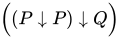
NOR has the interesting feature that all other logical operators can be expressed by interlaced NOR operations.
The logical NAND operator also has this ability.
Expressed in terms of NOR , the usual operators of propositional logic are:
|
| |||||||||||||||||||||
|
|




See also[edit]
|
|
|
References[edit]
- ^ Hans Kleine Büning; Theodor Lettmann (1999). Propositional logic: deduction and algorithms. Cambridge University Press. p. 2. ISBN 978-0-521-63017-7.
- ^ C.S. Peirce, CP 4.264
- ^ Hall, Eldon C. (1996), Journey to the Moon: The History of the Apollo Guidance Computer, Reston, Virginia, USA: AIAA, p. 196, ISBN 1-56347-185-X
External links[edit]
 Media related to Logical NOR at Wikimedia Commons


 Posts
Posts


No comments:
Post a Comment